On this trip, I had three goals:
-
Host a CETAF workshop at the Museo Nacional de Ciencias Naturales
-
Build a community with European users of Specify software
-
Explore Spanish culture, art, and food
Travel began with about 16 hours of transit between my home airport in Kansas City, Missouri and the Madrid airport in Spain.
Work
Specify Workshop
This was, by most measures, the most difficult workshop to prepare for. This is because it included four days, 9 hours a day, of course material. We had to have slide decks prepared, practiced demos, and live Q&A sessions covering topics raised by participants that we could often not anticipate. It took about 2 weeks of (mostly) concentrated preparation to put everything together. Theresa Miller and I spent quite a bit of time preparing with Michael Bublé or Tom Petty echoing in the background.
We had 31 in-person attendees and 27 online participants, representing over 14 countries. The attendees were exceptional. We started the workshop with the usual “pair up” icebreaker, but it quickly became clear that everyone was eager to collaborate, communicate, and share jokes as a group. Conversations and connections formed effortlessly. The room was filled with participants of varying skill levels, from those completely new to the software to those who have been using it for decades. It truly felt electric.
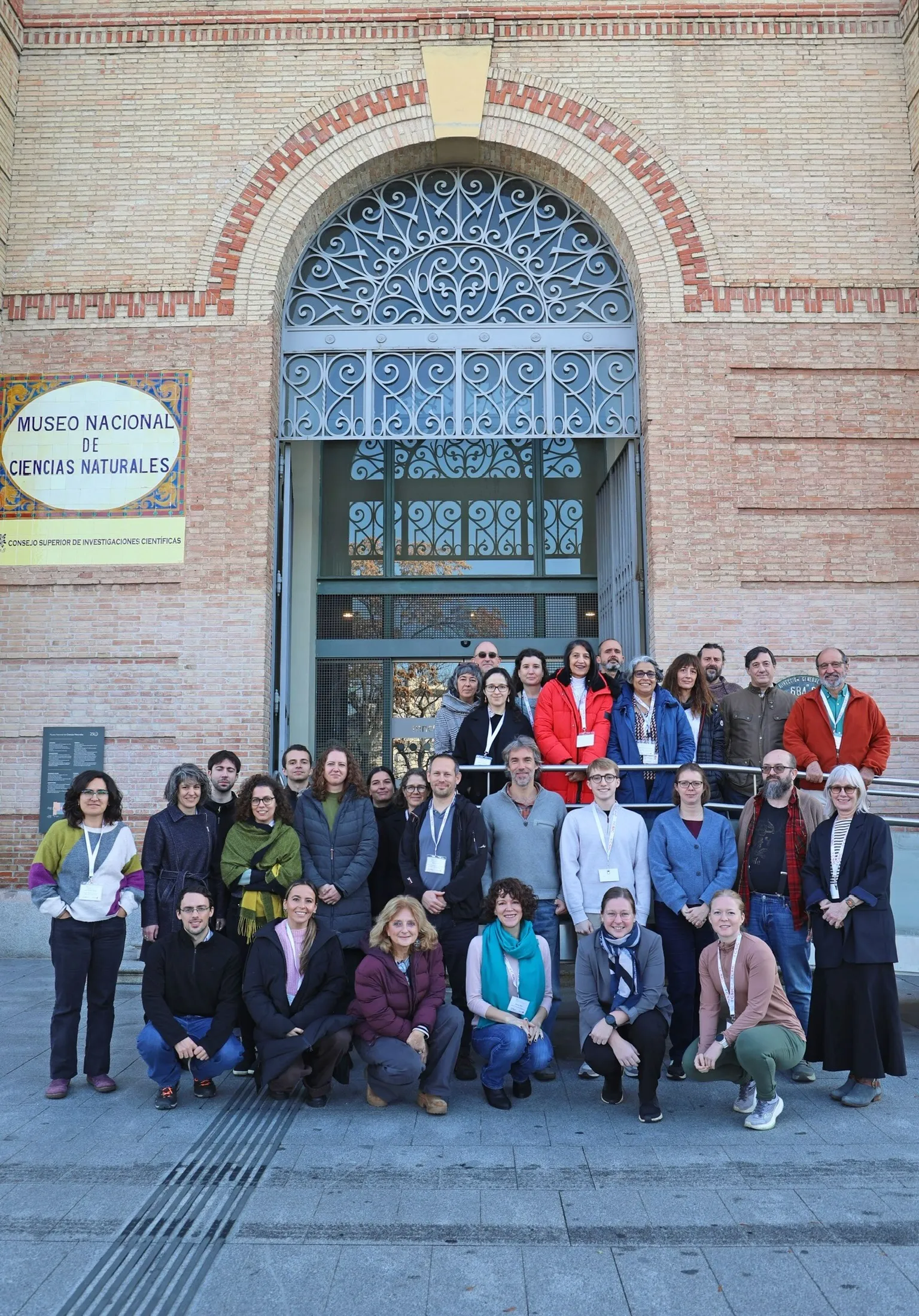
A photo of all workshop participants in front of the museum.


We had a 3-course lunch together as a group every day at the neighboring Restaurante de la Residencia de Estudiantes. The service (and the food) was excellent. It was a terrific venue for an event like ours, though we had so much fun we often exceeded the time allotted for lunch. I think it was absolutely worth it.
Dates: 9 – 12 December 2025
Location: National Museum of Natural History (CSIC), Madrid
Organizers: Grant Fitzsimmons, Theresa Miller, Dr. íñigo Granzow
Schedule:
Day 1 (Foundational & Customization)
The first day focuses on the foundational setup of the Specify system and deep dives into customization.
Pre-installation Decisions: Covers the initial setup aspects, including Data Model, Organizational Hierarchy, and Data Scoping.
Collection Objects and Relationships: Introduces fundamental data types like Collection Object Types, Collection Object Groups, and how to define their relationships.
Customizing Specify (Modules 3): This is a major theme, covering Schema Configuration and creating a tailored user experience by editing data entry forms, customizing table formats, setting up aggregation, implementing Conditional Forms, and defining Uniqueness Rules. It also includes customizing Reports and Labels.
The day concludes with a Small Group Discussion and Hands-On Practice.
Day 2 (Data Management & Cleanup)
The second day moves into specific tools for managing, cleaning, and transforming data within the system.
Trees (Module 4): Focuses on managing hierarchical data with functions like Synonymizing, Merging, Moving, and Modifying records.
WorkBench (Module 5): A key module for bulk data operations, including Importing Collection Objects and Taxonomy, and adding secondary data (Determinations, Preparations, Citations) to existing records, and managing Attachments.
Searching the Database (Module 6): Teaches users how to retrieve data effectively using the Query Builder, Simple Search, and managing Record Sets.
Data Cleanup (Module 7): Practical skills for maintaining data quality are covered with the Batch Editing and Record Merging tools.
The day features two separate periods for Hands-On Practice to reinforce the topics.
Day 3 (Advanced Functionality & Special Topics)
The third day addresses system auditing, complex data interactions, and specialized collection needs.
Statistics and Auditing (Module 8): Covers tools for tracking system usage and data quality.
Interactions (Module 9): A major module focusing on the management of all lifecycle and external transactions, including Accessions, Deaccessions, Disposals, Exchanges, Gifts, and Loans.
Attachments (Module 10): Covers the technical aspects of the Attachment Server, attaching individual files, and performing Bulk Attachment Uploads.
Geology & Paleontology (Module 11): A specialized module that details the use of the Geology Discipline and managing Component Parts.
The day includes Lightning Talks/Discussion and another Hands-On Practice session.
Day 4 (System Administration & Publishing)
The final day covers system-level topics, data publishing, and administrative duties.
Exporting Data (Module 12): Focuses on making data publicly accessible by mapping query fields to Darwin Core, configuring an RSS feed, and publishing to platforms like GBIF and iDigBio.
Permission System (Module 13): A deep dive into system administration, covering how to manage user roles and access rights.
The workshop concludes with a visit to the Collections at MNCN and the Certificate Ceremony.
Travel
Once the bulk of the workshop concluded, my brother joined me on my travels for the remainder of the journey.
Madrid


I spent the first week of the trip in Madrid as this was the center point for our conference. Íñigo Granzow showed our team around and was an absolute joy to work and explore with.
I had my first experience with Spanish tapas, and it was fantastic. Pair good company with wine, beer, or Coke Zero, along with patatas bravas (spicy potatoes with varying levels of heat), calamares fritos, Iberian jamón, pan con tomate, or even navajas (razor clams), and you will absolutely have a great time.
I had time to see everything on my list during my visit, and we had a chance to try some incredible restaurants (notably Taberna Alipio Ramos, Ni Subo Ni Bajo, and my favorite- Bodega de los Secretos).
While in Madrid, I had a chance to see:
-
National Museum of Natural Sciences (MNCN, CSIC)
- This was where I spent most of my daytime hours during the visit, next to the time our team spent together at the hotel.
-
Royal Palace of Madrid
-
Museo Nacional del Prado
-
Plaza Mayor (too many times)
-
Museo Nacional Centro de Arte Reina Sofía
-
Mercado de San Miguel
-
Temple of Debod (perfect at sunset)
-
Gran Vía (holiday lights and shopping)
-
Royal Basilica of Saint Francis the Great
-
Real Jardín Botánico (with a wonderful tour of the gardens and collections space by Jesús Muñoz)
-
Puerta del Sol (and a live show celebrating the history of Spain)
-
Retiro Park


If you’re going to visit Spain, Christmas time is not a bad time to explore.


One of my favorite museums was surprisingly the OXO Museo del Videojuego Madrid. The exhibits were incredibly well made and featured incredible hands-on demonstrations of classic video game hardware. As a vintage computer collector/enthusiast and big museum fan, I was excitedly moving between exhibits for the entire 1.5 hour time slot we were given with the purchase of a ticket.

Seville
As a child, I lived in the suburbs of Kansas City, so Seville was naturally the first city in Spain I learned about. It is considered the first “sister city” because Kansas City was invited to exhibit at the 1992 World’s Fair in Seville.
A prominent landmark in Kansas City is The Giralda, which was inspired by developer J. C. Nichols’ visit to Seville in the 1920s. He constructed a half-scale replica of the iconic Spanish Giralda. During my first visit to the full-scale structure, I was struck by its grandeur. It’s no surprise that such an impressive monument, showcasing Moorish architecture and steeped in history, would inspire Nichols to create something only half as great. Today, J.C. Nichols is remembered as a key figure in Kansas City’s development, but he was also an ardent segregationist. I find it profoundly ironic that a man with his views would construct a monument with so much cultural fusion.


From what I can gather, life in Seville offers a vastly different lifestyle compared to what I’m used to in Kansas. The area is romantic and historic, with many more people densely packed into a beautiful, walkable city. Perhaps someday I’ll live in a place as storied and outdoor-oriented.
My brother and I had time to visit:
-
Royal Alcázar of Seville
-
Setas de Sevilla (plus hours of live entertainment by various incredible buskers)
-
Catedral de Sevilla (including the bell tower climb)
-
Parque de María Luisa
-
Torre del Oro
-
Santa Cruz (an incredible neighborhood)
-
Murillo Gardens


Toledo
Our time in Toledo was short, but we had some incredibly unique experiences.
-
The Alcantara Bridge welcomed us into town
-
Castillo de San Servando
-
Puerta del Sol
-
Museum of Santa Cruz
-
Plaza de Zocodover
-
Toledo train station (incredible Mudéjar architecture)
-
Puerta de Alfonso VI


While many places began to close, we noticed an advertisement posted on the side of a bus stop: a show called ‘Circo Encantado’, made for families styled around ‘horror’ featuring two clowns (Paute and Capitano) arriving at a mansion of Doña Terrorífica, the ringleader of a large assortment of acrobats, jugglers, and other performers.
The show was entirely in Spanish, though fortunately my years of Spanish lessons in the American public school system paid enough dividends that I could follow most of the humor. The same cannot be said for my brother, which gave me the opportunity to translate the bits he missed quietly while we watched the performance.
We didn’t catch a traditional flamenco show, but we found something stranger and equally fun: a horror circus.

I eagerly await my next visit to Spain. I sincerely thank everyone who made this trip such a success.